Mortgage Business Growth
The Complete Mortgage Loan Officer Marketing Guide for 2026
Our pillar guide connecting every part of loan officer marketing: positioning, website, search, referrals, CRM, automation, AI and a realistic 12-month plan.
By Mortgage Site Pros Editorial Team · Published · Updated
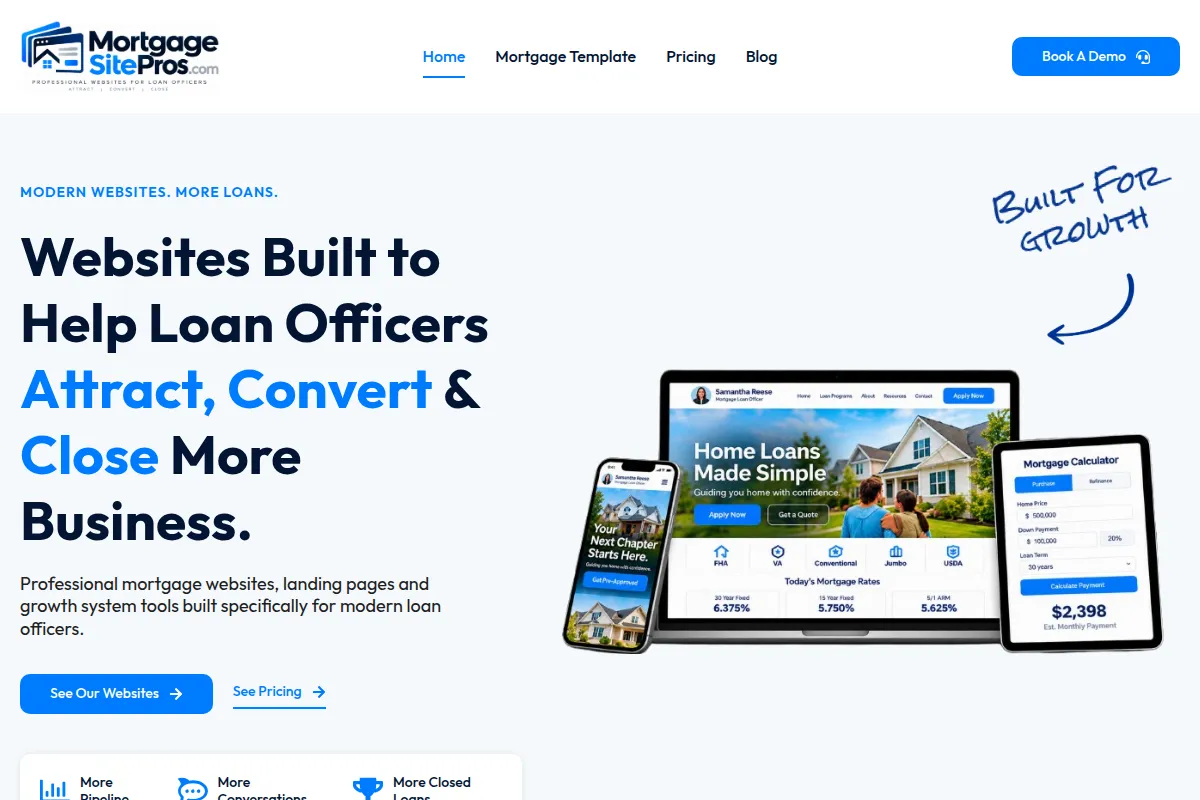
Mortgage loan officer marketing in 2026 is about building a system rather than chasing tactics: a clear position in a defined market, a website that converts, visibility in local and AI-assisted search, relationships with realtors and past clients, a CRM that remembers everyone, and follow-up that never lets an inquiry go cold. Each piece supports the others. Weakness in one, usually follow-up, undermines the rest.
This pillar guide connects the eleven focused articles on our blog. Read it top to bottom for the full picture, or jump to the area you most need. Throughout, we avoid invented statistics and guaranteed outcomes. What we offer instead is a structure that experienced loan officers will recognize and a plan you can actually execute alongside a full pipeline.
A quick note on scope: this is marketing and technology guidance, not legal or compliance advice. Mortgage advertising, texting, referral relationships and data handling are regulated. Your company’s compliance team should review your marketing before it goes live.
The loan officer marketing system at a glance
Think of your marketing as five layers. Each layer has a dedicated article for depth.
| Layer | Job | Go deeper |
|---|---|---|
| Foundation | Positioning and a website that converts | Best loan officer websites, mortgage website templates |
| Visibility | Being found in search and AI answers | Mortgage SEO |
| Demand | Generating inquiries and referrals | How to get mortgage leads, lead generation without buying lists, realtor referral marketing |
| Conversion | Capturing, organizing and following up | Mortgage CRM, lead follow-up, marketing automation |
| Leverage | Saving time with AI, carefully | AI for loan officers, AI chatbots |
Step 1: Define your position and market
Before choosing tactics, answer three questions in writing. Who do you serve best? Where are you licensed and active? Why should someone choose you over the next loan officer or a national lender?
Good answers are specific. First-time buyers and VA families in two counties. Self-employed borrowers across the states where you are licensed. New-construction buyers working with three local builders. Specificity makes every later decision easier: what content to write, which partners to approach, what your homepage says.
- Review your last two years of closings for patterns in loan type, geography and referral source.
- Choose one primary audience and at most two secondary ones.
- Write a one-sentence positioning statement and use it in your homepage headline and social bios.
- Confirm with compliance any program or geography claims.
Step 2: Build a website that converts
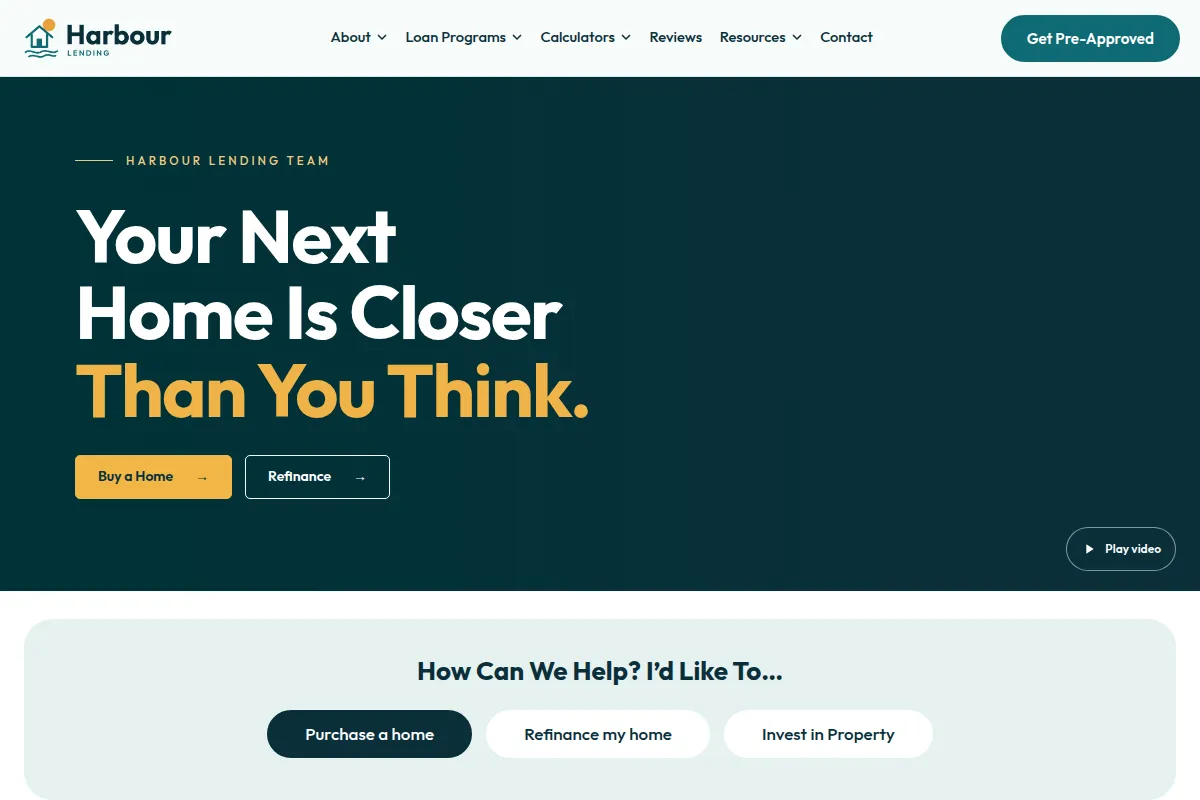
Every channel ends with someone looking you up. Your website has to confirm, in seconds, that you serve them, that you are licensed and real, and how to start. Our guide to the best mortgage loan officer websites breaks down eight criteria, from positioning and trust signals to mobile speed and lead routing.
Most loan officers do not need a custom build. A mortgage-specific template, customized with real photos, copy and licensing, covers what borrowers need. Use our template selection framework to match a layout to your business model, then browse the live template previews.


Step 3: Get found in Google and AI search
Search visibility for a loan officer is mostly local. Complete your Google Business Profile where your company allows it, keep business information consistent, and publish pages that answer borrower questions in your markets. The mortgage SEO guide includes a 90-day plan.
On AI search, Google’s documentation on AI features states there are no extra requirements or special markup to appear in AI Overviews or AI Mode; standard SEO best practices apply. Clear headings, direct answers, accurate facts and cited sources help every system understand your pages. Structured data should describe only what is visible and does not guarantee appearance.
Step 4: Generate demand you own
Lead generation works best as a portfolio. Our list of 15 strategies to get more mortgage leads groups options by effort and timeline. If purchased leads dominate your budget, the guide to generating leads without buying lists shows how to shift gradually toward owned sources: website, search, content, partners and database.
Past clients and your database
Your past clients are often your most efficient source. Import closings with dates into your CRM, schedule anniversary check-ins and send a useful monthly email that follows CAN-SPAM requirements.
Realtor and referral partners
Agents send business to lenders who make deals close smoothly and communicate proactively. The realtor referral marketing playbook covers CRM structure, partner workflows and RESPA guardrails. Review co-marketing with compliance using the CFPB RESPA FAQs.
Content and social
One useful article a month, repurposed into email and short social posts, builds visibility steadily. Every piece should point back to your website.
Step 5: Organize everything in a CRM
A CRM is where leads, borrowers, partners and past clients live, with tasks and history. Choose based on daily usability, LOS integration, lead capture, consent-aware texting and company approval. Our mortgage CRM guide includes a weighted scoring sheet and notes how vendors such as Jungo and Total Expert describe their lead features.
The most important connection is from your website to your CRM, so every inquiry is recorded, assigned and followed up. That connection should be scoped and tested, including consent fields.
Step 6: Follow up consistently
Follow-up is where most marketing spend is won or lost. Acknowledge immediately, call promptly, make several attempts over the first two weeks, then move people who are not ready to useful long-term nurture. Our lead follow-up guide includes a sample sequence and message frameworks, and the marketing automation guide shows how to build triggers, conditions and actions for new leads, milestones, partners and past clients.
| Stage | Automate | Keep personal |
|---|---|---|
| New inquiry | Acknowledgment, call task | First conversation |
| Pre-approval | Expiration reminders | Offer strategy discussion |
| In process | Milestone updates | Delays and problems |
| Closed | Anniversary notes | Reviews and referral asks |
| Not ready | Monthly useful email | Replies |
Step 7: Use AI where it actually helps
AI is a drafting and organizing assistant: emails, summaries, outlines, checklists and repurposed content. It does not make lending eligibility decisions and does not replace licensed or compliance review. The AI for loan officers guide lists ten practical uses with guardrails.
Website chatbots are optional. They can capture after-hours questions with strict guardrails and quick human handoff, but a short form and fast response often serve as well. Read AI chatbots for mortgage websites before adding one.
Compliance foundations for every channel
Compliance is not a final step; it shapes each channel. These are the areas to raise with your compliance team.
| Area | Applies to | Reference |
|---|---|---|
| Licensing disclosures | Website, ads, social, email signatures | Company policy; NMLS Consumer Access for consistency |
| Commercial email | Newsletters, drips | FTC CAN-SPAM guide |
| Texting and calls | Follow-up, reminders | FCC guidance |
| Referral relationships | Realtor co-marketing | CFPB RESPA FAQs |
| Fair lending | Copy, targeting, AI drafts | CFPB Regulation B |
| Rate and term advertising | Website, ads | Company compliance approval |
A realistic 12-month marketing plan
This plan assumes a working loan officer with a few hours per week for marketing. Adjust the pace, not the order.
| Months | Focus | Outcomes to aim for |
|---|---|---|
| 1 to 2 | Positioning, website launch or refresh, compliance review | Clear site with licensing, working forms, analytics |
| 2 to 3 | CRM setup, website-to-CRM connection, new-lead follow-up sequence | Every inquiry logged and acknowledged |
| 3 to 4 | Past client import and anniversary workflow; Google Business Profile | Database reactivated, local profile complete |
| 4 to 6 | Realtor partner program; milestone updates | Defined partner list and communication rhythm |
| 5 to 12 | Monthly article, newsletter, quarterly SEO review | Growing library of local content |
| Quarterly | Review source-to-application reporting | Invest more in what works |
Common marketing mistakes loan officers make
Most stalled marketing plans fail for predictable reasons. Recognizing them early saves months.
Starting with tactics instead of position
Running ads or posting daily before deciding who you serve produces scattered results. Positioning makes every channel sharper, from your homepage headline to the agents you approach.
Investing in visibility before conversion
Paying for traffic or leads while your website is unclear and follow-up is inconsistent is the most expensive mistake. Fix the site and the follow-up sequence first, then add visibility. That order is why this guide places the website and CRM before demand generation.
Treating automation as a replacement for relationships
Long generic drips do not build trust. Automation should guarantee that nobody is forgotten and that you know who to call; the relationship still runs through you. See mortgage marketing automation.
Inventing proof
Fabricated testimonials, borrowed statistics and unsupported claims damage trust and create compliance exposure. Use real, permissioned reviews and cite primary sources. When you lack proof, describe your process honestly instead.
Never revisiting the plan
Markets, programs and company policies change. Schedule a quarterly review: update your website, retire content that is out of date, check disclosures and move time toward channels that produce applications.
Adapting the plan for teams and branches
Teams follow the same layers with added coordination. Decide who owns each layer: one person maintains the website and content calendar, one manages the CRM and lead routing rules, and each loan officer owns personal follow-up and partner relationships.
A team site needs individual profiles with photos, roles and NMLS IDs, plus clear routing so an inquiry reaches the right person. Lead assignment rules in the CRM should be written down and reviewed, especially for round-robin routing. Shared content, such as a monthly market article, can be written once and distributed by every loan officer under their own name where company policy allows.
- Agree on a shared positioning statement and individual specialties.
- Use a team-oriented template such as Team Advantage.
- Report results by source and by loan officer monthly.
- Keep one approved library of templates for email and SMS.
An integrated 90-day launch plan
The 12-month plan sets direction. This 90-day plan shows how the layers interlock in the first quarter, with each phase depending on the one before it.
| Days | Foundation | Conversion | Demand | Owner |
|---|---|---|---|---|
| 1 to 15 | Positioning statement; website audit; compliance review of footer and copy | Choose or confirm CRM | List past clients and top ten agents | Loan officer, compliance |
| 16 to 30 | Launch or refresh website; analytics for forms and calls | Website-to-CRM connection tested; consent fields mapped | Google Business Profile completed where permitted | Web provider, loan officer |
| 31 to 45 | Publish first local article | New-lead sequence live with suppression rules tested | Past-client calls weekly; anniversary workflow live | Loan officer, assistant |
| 46 to 60 | Second article; internal links to programs | Milestone updates for borrowers and agents | Two partner meetings per week | Loan officer |
| 61 to 75 | Refresh titles and descriptions using Search Console queries | Review replies, opt-outs and response times | First monthly newsletter | Assistant, loan officer |
| 76 to 90 | Third article | Source-to-application report | Decide next channel using the checklist | Loan officer |
Budget allocation trade-offs
There is no correct percentage split, and we will not invent one. Instead, think in trade-offs between cash and time, and between speed and compounding.
- Fund the foundation first; every other dollar depends on it converting.
- If cash is tight and time is available, favor partners, past clients and content.
- If time is tight and cash is available, paid sources can fill gaps, but only with strong follow-up already running.
- Revisit allocation quarterly using cost and time per funded loan.
| Option | Cash cost | Time cost | Speed | Compounds? |
|---|---|---|---|---|
| Website and CRM foundation | Moderate upfront, then ongoing | Moderate at setup | Enables everything else | Yes |
| Purchased leads | Ongoing per lead | High follow-up effort | Fast | No |
| Paid search | Ongoing | Moderate management | Fast | Only while spending |
| Content and SEO | Low to moderate | Steady | Slow | Yes |
| Referral partnerships | Low | High | Medium | Yes |
| Past-client marketing | Low | Low to moderate | Medium | Yes |
Metric definitions to use consistently
Metrics only help if everyone defines them the same way month after month.
| Metric | Definition |
|---|---|
| Lead | A person who contacted you or was referred with contact details and a stated need |
| Contact | A two-way conversation by phone, text or meeting, not just a sent message |
| Speed to contact | Time from lead arrival to first two-way conversation |
| Application | A submitted loan application in your LOS |
| Funded loan | A loan that closed and funded |
| Source | The channel that first brought the lead, recorded at entry |
| Partner referral | A lead a specific partner introduced, attributed to that partner |
Measuring what matters
Track leads by source, contacts made, applications and funded loans. Traffic and followers are leading indicators at best. After two or three quarters, your own data will tell you more than any industry average.
- Lead source captured on every inquiry.
- Time to first human contact.
- Applications and funded loans by source.
- Partner referrals by agent.
- Unsubscribe and opt-out trends.
Frequently asked questions
What is the most important part of loan officer marketing?
Consistent follow-up on top of a clear website. Without both, spending on visibility or leads leaks away.
How much should a loan officer spend on marketing?
There is no universal figure. Track cost per funded loan by source and invest more where results are proven. Owned channels mostly cost time.
Is SEO worth it for individual loan officers?
Local SEO usually is, because you have local expertise national sites lack. Expect it to build over months.
Does AI change mortgage marketing in 2026?
It speeds up drafting and organizing and changes how search answers appear, but fundamentals are the same: helpful content, trust, relationships and follow-up. AI does not replace licensed or compliance review.
Where should I start if I have limited time?
Fix your website basics, connect forms to a CRM, set up a new-lead follow-up sequence and reconnect with past clients. Add content and partner programs next.
Can Mortgage Site Pros help with all of this?
We build mortgage websites from proven templates. CRM, automation and AI integrations are options we scope and confirm per project. See pricing or contact us.
Sources and further reading
- Google Search Central: AI features and your website
- Google Search Central: Creating helpful, reliable, people-first content
- Google Search Central: Guidance on using generative AI content
- FTC: CAN-SPAM Act compliance guide for business
- FCC: Stop unwanted robocalls and texts
- CFPB: Real Estate Settlement Procedures Act FAQs
- CFPB: Regulation B (Equal Credit Opportunity Act)
- NMLS Consumer Access
- Google Business Profile: Guidelines for representing your business
Build your marketing foundation
Start with a mortgage website built from proven templates, then talk with us about the integrations your system needs.
Explore templates